LEVITAS: Levitodynamics for Accurate Individual Particle Sensing in Space
LEVITAS is a research programme developing an in-situ sensor for the rarefied media of the upper atmosphere, exosphere, and wider solar system. It grew out of an idea within LOTIS, with partners at Warwick and Strathclyde.
Concept
LEVITAS uses a single optically trapped nanoparticle, exposed to the space environment, as a sensor. Each gas particle from the surrounding medium that strikes it delivers a small momentum kick, and from the recoil the momentum of this impact is inferred.
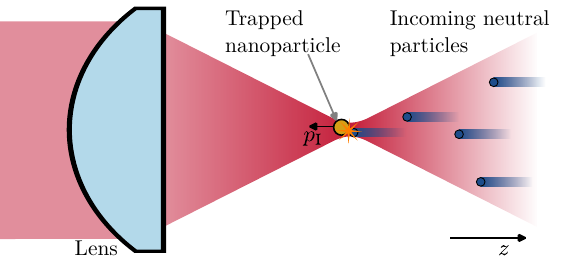
The nanoparticle’s motion is continuously monitored with sufficient bandwidth and precision that these individual impact events are resolved.
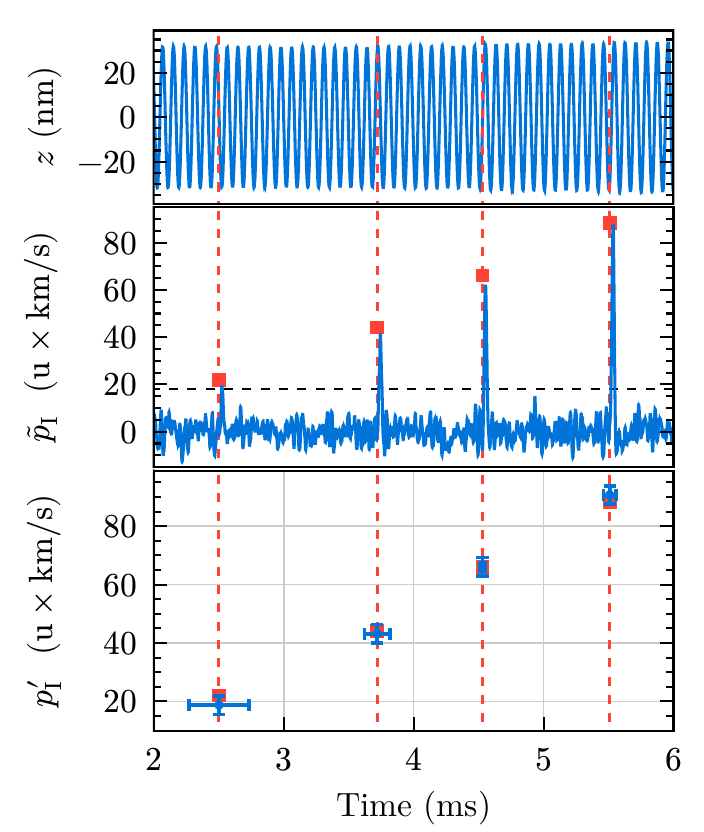
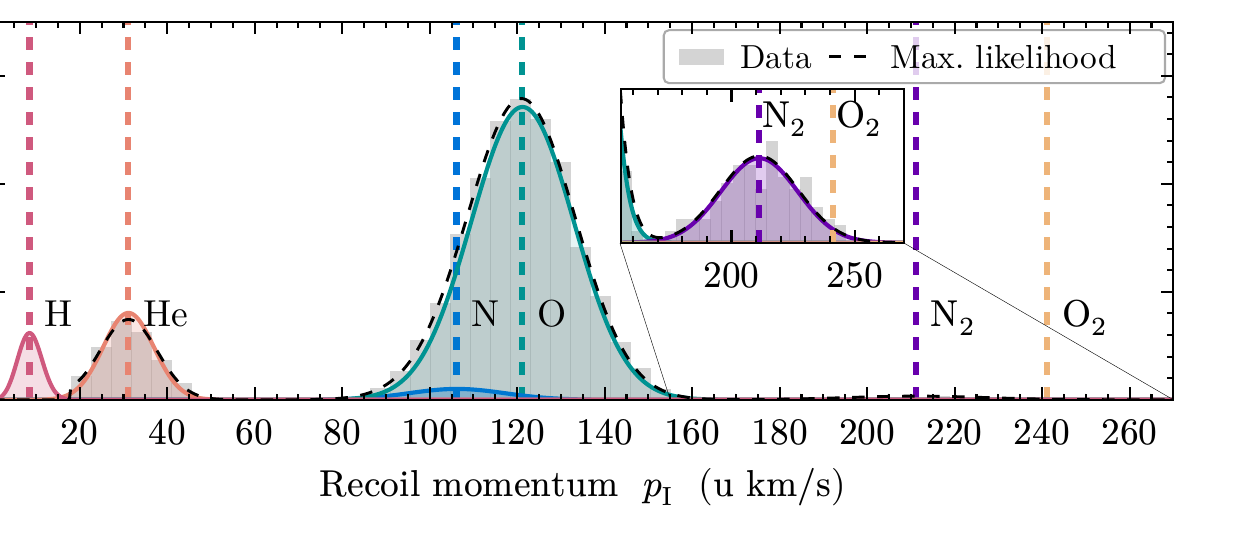
From the record of impacts, the density, velocity, temperature, and composition of the surrounding medium can be estimated. LEVITAS works from low Earth orbit out to exospheric distances, and reaches into very different regions of momentum space, for example the high-velocity neutral gas from the interstellar medium that penetrates the heliosphere and flows through the solar system.
Studies
- ESA funded the QSEO design study for its Quantum Sensors for Earth Observation (QSEO) initiative, which established the LEVITAS concept and led to the paper below.
- A follow-on experimental study is in preparation.
Paper
R. Gajewski, R. T. Desai, J. Bateman, B. Eliasson, D. K. L. Oi, and A. Datta, LEVITAS: Levitodynamics for accurate individual particle sensing in space, Quantum Science and Technology 11, 045034 (2026); preprint at arXiv:2510.24524.
Related work
Closely related ideas explored elsewhere:
- Y.-H. Tseng et al., Optomechanical Detection of Individual Gas Collisions, arXiv:2604.18371 (2026).
- M. Perdriat et al., Single-atom detection with a quantum-controlled mechanical oscillator, arXiv:2608.17656 (2026).